



CausalX.ai on Databricks
An Open Causal Intelligence
Layer for Enterprise Decisioning

Executive takeaway
Celebal Tech's CausalX.ai combines industry ontology, causal reasoning, Databricks business semantics, Genie experiences, Agent Bricks, Lakeflow Connect, Lakehouse//RT, Lakebase, Databricks Apps, Lakewatch, and Databricks One / Genie One to create a transparent, reusable, and cost-efficient decision framework on the customer's own lakehouse.
The Decisioning challenge
Enterprise leaders are not only asking whether they can collect more data. They are also asking whether they can trust the reasoning that converts data into decisions. Many large transformation programs have historically addressed this challenge through closed, services-heavy decision platforms where business logic, workflows, and operational intelligence are embedded inside proprietary implementation layers. While that model can create short-term acceleration, it often increases long-term dependency, cost, and opacity. Celebal Tech's CausalX.ai, built on Databricks, offers a more open alternative: an enterprise-owned causal intelligence layer where data, ontology, semantics, agents, applications, and actions are governed on the customer's lakehouse foundation.
This approach is fundamentally different from building another isolated decision stack. CausalX.ai is designed to run close to governed enterprise data, reuse existing lakehouse investments, and expose the logic behind business recommendations. The objective is not simply to generate answers; it is to create explainable decisions that leaders can inspect, challenge, simulate, approve, and operationalize.
Ontology as an executable business layer
At the core of CausalX.ai is ontology, but not as a static knowledge graph or documentation exercise. CausalX.ai treats ontology as a governed representation of how the business actually operates: customers, products, assets, suppliers, policies, contracts, risks, events, KPIs, constraints, and possible actions are connected through business meaning. Databricks strengthens this foundation through Unity Catalog business semantics, which centralizes definitions of business metrics and KPIs so that BI, AI, and operational applications interpret enterprise language consistently.
With Databricks Genie and Genie Ontology, business users gain a governed natural-language experience grounded in enterprise data, dashboards, metric views, and business context. CausalX.ai extends this foundation by adding industry-specific ontology and causal relationships. The result is a business layer that not only defines what a term means, but also shows how outcomes are influenced, which constraints matter, and which actions can change the result.
Process Diagram: CausalX.ai on Databricks
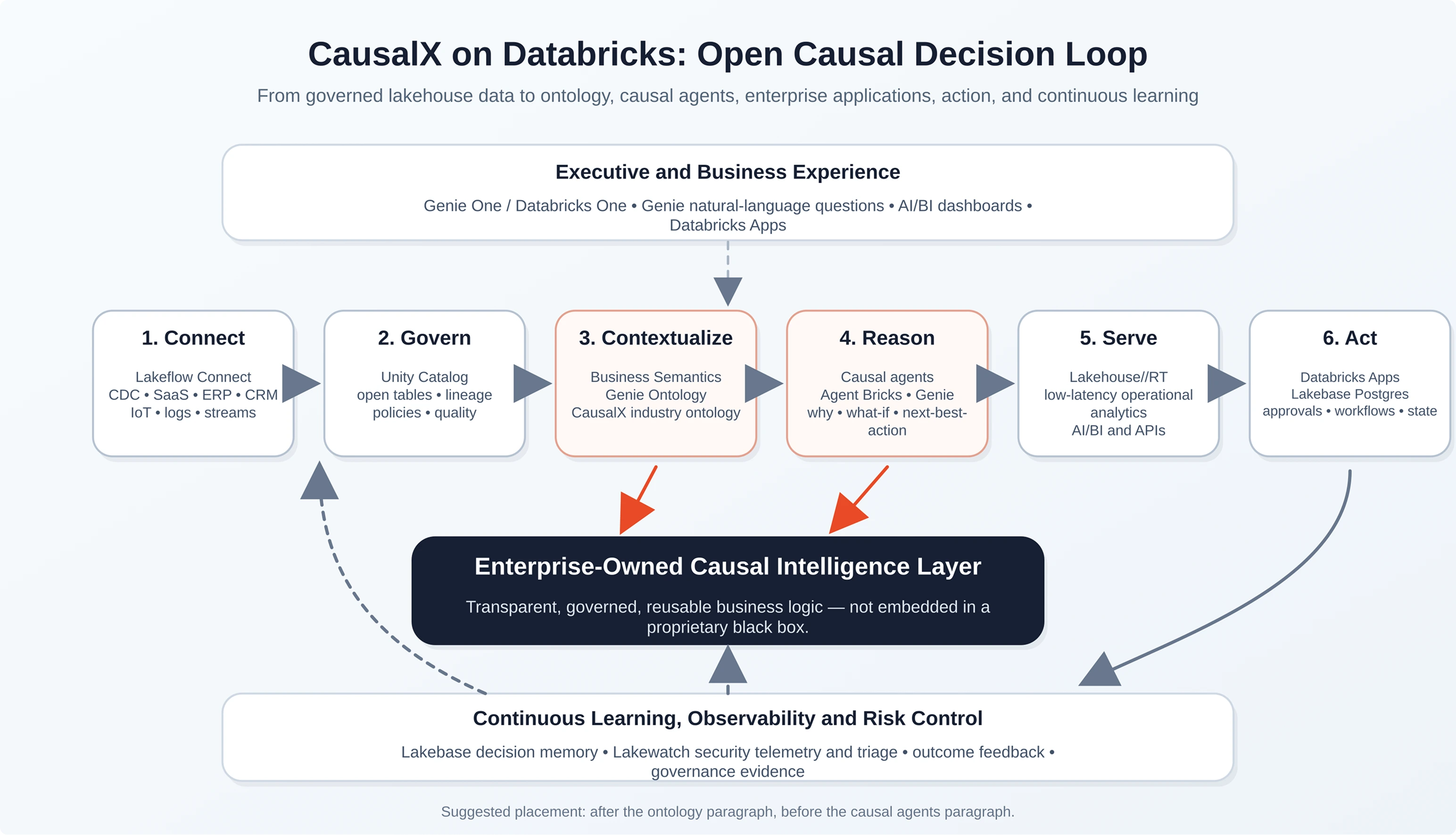
Figure 1. CausalX.ai creates an open causal decision loop by connecting governed data, ontology, causal agents, real-time serving, applications, action, and continuous learning on Databricks.
From semantic graph to causal intelligence
A traditional graph can show that a customer is connected to a product, a region, a campaign, a service issue, and a renewal risk. CausalX.ai asks the higher-value question: which of these relationships explains the outcome, and what intervention can change it? In manufacturing, this means connecting asset health, shift patterns, maintenance events, material variability, quality defects, and throughput loss. In banking and insurance, it means connecting exposure, liquidity, fraud patterns, regulatory constraints, customer behavior, and portfolio outcomes. In healthcare, it means connecting patient journeys, provider actions, clinical pathways, utilization, outcomes, and cost drivers. In retail and CPG, it means connecting demand, promotion, pricing, inventory, channel mix, customer segments, and margin leakage.
This is the shift from a descriptive graph to a causal operating model. Instead of relying on correlation-only narratives, CausalX.ai connects qualitative business semantics with causal structures, assumptions, interventions, and counterfactual reasoning. Leaders can see not only what changed, but why it changed, which drivers were material, and what action is most likely to improve the outcome.
Data-to-action architecture on Databricks
The architecture is especially powerful because it sits close to the data rather than forcing data into another proprietary operational layer. Lakeflow Connect can bring data from SaaS applications, databases, files, CDC pipelines, logs, IoT streams, and operational systems into governed Databricks pipelines. Unity Catalog provides a governance backbone for access, lineage, policies, and shared definitions, while open table formats and zero-copy patterns help reduce unnecessary data movement and duplicated data estates.
Lakehouse RT supports low-latency, high-concurrency read workloads on governed tables, which is critical when causal intelligence must support executive decisioning, real-time operational applications, APIs, and AI/BI experiences. In practical terms, CausalX.ai uses the lakehouse as the system of intelligence: fresh data is connected, governed, contextualized, reasoned over, served, acted upon, and continuously improved.
Governed causal agents and business experience
The differentiator is the combination of ontology and causal agents. With Agent Bricks, CausalX.ai can deploy governed enterprise agents that reason over business data, respect identity and access controls, use approved tools, and operate with observability across the data and AI estate. These agents do more than summarize trends. They traverse the ontology, evaluate competing causal hypotheses, identify drivers, simulate interventions, explain assumptions, and recommend next-best actions.
For a CXO, this changes the conversation from "What happened last quarter?" to "Why did it happen, what can we do about it, what impact should we expect, and what risks should we monitor?" For business users, Genie and Databricks One / Genie One become the conversational and application front door, allowing leaders to interact with governed intelligence without needing to navigate technical assets such as notebooks, compute clusters, or data models.
Applications, state, and memory with Lakebase
CausalX.ai also closes the loop from insight to action. Databricks Apps enables secure data and AI applications to be built and deployed directly on Databricks, integrated with Unity Catalog, Databricks SQL, authentication, and serverless infrastructure. Lakebase provides the transactional foundation for low-latency applications, scenario state, workflow approvals, durable agent memory, and feedback from outcomes back into the decision loop.
This matters because enterprise AI cannot remain advisory forever. A business user can ask Genie why margin declined in a region; CausalX.ai can identify the causal drivers, simulate corrective actions, present an approved workflow in a Databricks App, persist the decision context in Lakebase, and feed the observed result back into future recommendations. The same platform can therefore support questions, explanations, simulations, decisions, actions, and learning.
Trust, observability, and resilience
The same foundation supports resilience, governance, and security-sensitive operations. Lakewatch brings an agentic security and observability model to the lakehouse, helping enterprises use lakehouse-scale telemetry for rule authoring, normalization, triage, and response. For CausalX.ai, this is strategically important because enterprise decisioning cannot be separated from trust. Every causal recommendation must be traceable to data, semantics, ontology, assumptions, policy constraints, and observed outcomes.
By combining Unity Catalog governance, Genie experiences, Agent Bricks, Lakebase, Databricks Apps, Lakehouse RT, Lake-flow Connect, Lake-watch, and CausalX.ai industry ontologies and Causal Agents, enterprises can create a transparent decision framework rather than another opaque layer of automation. This makes the system more auditable, more reusable, and more aligned with how regulated and complex organizations actually make decisions.
Cost and openness advantage
Cost is a major differentiator. Closed, forward-deployed-engineering-style platforms often require specialized implementation teams, duplicated pipelines, proprietary semantic models, and custom operational layers that are expensive to scale across business domains. CausalX.ai on Databricks is designed to reuse the enterprise's existing lakehouse investments: governed data, open tables, business semantics, ingestion pipelines, AI/BI assets, low-latency serving, agent governance, application infrastructure, and transactional state.
Instead of funding a separate black-box implementation for every domain, organizations can build reusable causal ontologies and agent patterns once, then apply them across manufacturing, finance, supply chain, customer experience, risk, operations, security, and executive planning. For CIOs and business leaders, the value is clear: lower marginal cost per use case, greater transparency, faster reuse, stronger enterprise control, and less dependency on proprietary delivery models.
Strategic conclusion
CausalX.ai powered by Databricks is an open causal decision platform. It helps enterprises move from dashboards to explanations, from explanations to interventions, and from interventions to governed action. Most importantly, it allows leaders to own the logic behind their decisions. In an era where AI will increasingly influence operational, financial, and strategic choices, that ownership matters.
The winning enterprise architecture will not be the one that hides intelligence inside a proprietary black box. It will be the one that makes intelligence explainable, causal, governed, reusable, and actionable. That is the role of Celebal Tech's CausalX.ai on Databricks: to help organizations ask better why questions, understand causal drivers, and act with confidence on an open, governed, cost-efficient platform.
Architecture at a glance
The following view summarizes how Databricks components contribute to the CausalX.ai operating model.
| Capability area | Databricks components | Role in CausalX.ai | Business outcome |
|---|---|---|---|
| Data onboarding and freshness | Lakeflow Connect; Streaming; CDC | Connects enterprise, SaaS, operational, and event data into governed pipelines. | Faster reuse of operational data with less integration drag. |
| Governance and business meaning | Unity Catalog; Business semantics; Genie Ontology | Defines access, lineage, metrics, terms, relationships, and business context. | Consistent enterprise language and explainable decisions. |
| Business experience | Databricks One / Genie One; Genie; AI/BI Dashboards | Provides a natural-language and dashboard experience for business users. | Broader adoption without requiring users to work in technical tools. |
| Causal reasoning | Agent Bricks; CausalX.ai causal agents | Evaluates drivers, causal hypotheses, counterfactuals, and intervention options. | Why/what-if/next-best-action recommendations with traceability. |
| Serving and action | Lakehouse//RT; Databricks Apps; Lakebase | Serves low-latency intelligence, applications, workflows, state, and agent memory. | Moves from insight to approved action with auditability. |
| Observability and resilience | Lakewatch; Unity Catalog | Supports telemetry, triage, governance evidence, and risk controls. | Trusted operations for enterprise-scale decisioning. |